The capital city of Madhya Pradesh, Bhopal, is not only known for its lakes but also for its lush greenery and well-balanced urban planning. Nestled amidst this greenery lies Van Vihar National Park, a unique natural heaven that redefines the traditional concept of a zoo. Its guiding principle is simple yet profound — “Conservation, not exhibition.”
Spread over about 445 hectares on the southern bank of the Upper Lake, Van Vihar was established in 1983 and later declared a National Park in 1996. Since then, it has evolved into a model eco-sensitive zone where wildlife is preserved in its natural habitat rather than displayed in captivity.
The harmonious blend of Water, Greenery, and Life
Van Vihar National Park holds a special identity due to its exceptional geographic setting. It serves as a bridge between urban life and natural beauty. Stretching along the Upper Lake, it truly embodies Bhopal’s title — “City of Lakes and Greens.”
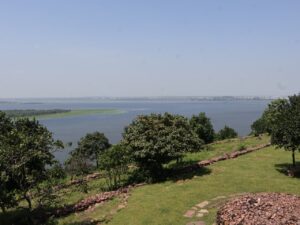
This park is not merely a wildlife zone but a living dialogue between nature and the city. Its most remarkable feature is the serene harmony between the blue waters of the lake and the green expanse of the forest — a landscape that soothes both the eyes and the soul.
Mornings here are especially magical: mist floats gently over the lake’s surface, birds call out from the distance, and golden rays of sunlight filter through the trees — creating a scene that feels painted by nature itself.
The calm and purity of the atmosphere allow every visitor to disconnect from the chaos of city life and reconnect with themselves.
A walk through Van Vihar or simply sitting by the lake is more than recreation — it is a spiritual experience. One feels an intimate bond with every element of nature — the air, the water, the trees, and the wildlife — a connection that arises not from curiosity, but from inner peace and belonging.
The lake sustains Van Vihar’s ecological balance. It serves as a lifeline for birds, animals, and the surrounding vegetation. During winters, the arrival of migratory birds like Siberian species adds color and vibrancy to this natural confluence.
When visitors feel the cool lake breeze and see deer running freely across open meadows, time seems to stand still.
This unique blend of lake and forest has become an integral part of Bhopal’s identity — a place where the noise of the city fades and the voice of nature prevails.
Van Vihar teaches us that even amidst modern chaos, staying connected to nature rejuvenates the soul. It is truly a place where the coolness of the lake and the freshness of the forest come together to revive the rhythm of life.
A Treasure of Biodiversity
Van Vihar is home to over 60 species of mammals, more than 300 bird species, and over 40 reptile species.
During the winter season, it becomes a paradise for migratory birds like Siberian geese, cormorants, painted storks, egrets, and kingfishers that flock to its wetlands and reservoirs.
The area also forms part of the Narmada–Betwa basin, giving rise to rich and diverse vegetation. Trees like sal, teak, khair, neem, amla, and karanj cover the landscape, keeping the region naturally cool and green.
A Unique Concept: “Not a Zoo, but a Conservation Zone”
Van Vihar National Park is one of India’s rare sites that takes wildlife conservation beyond the confines of a traditional zoo.
Its core philosophy is — “Conservation, not exhibition.”
In most zoos, animals are confined to iron cages, living away from their natural behavior in artificial surroundings. While visitors see them, they rarely understand their true instincts or way of life.
Van Vihar changes this perception entirely.
No animal here is captured from the wild. Instead, the park shelters injured, aged, orphaned, or rescued animals — those freed from circuses, illegal trafficking, or private captivity.
These animals are treated and given a safe environment where they can live naturally. For this reason, Van Vihar is also known as a “Rescue and Rehabilitation Centre.”
The park’s open enclosures are its biggest highlight. Lions, tigers, and leopards roam freely within large, natural zones secured by high fences — not cages. Similarly, bears, deer, nilgai, crocodiles, snakes, and various bird species live safely within their natural surroundings.
Through this model, Van Vihar proves that wildlife conservation is not about display but about compassion and responsibility.
It demonstrates that when humans approach nature with understanding, they become its greatest protectors.
‘No Vehicle Zone’: A Step Toward a Greener Future
Recently, Van Vihar has initiated a commendable step — transforming the park into a “No Vehicle Zone.”
The main goal is to maintain a pollution-free and peaceful environment, protecting animals from noise, smoke, and harmful emissions.
Entry of diesel and petrol vehicles is being restricted. Instead, electric vehicles, bicycles, and walking trails are being encouraged.
This initiative not only benefits the environment but also gives visitors a closer, more immersive experience of nature.
The park administration believes that reduced noise and cleaner air make animals more comfortable and improve their health and behavior.
Thus, the “No Vehicle Zone” is not merely an environmental move — it’s a commitment to leave a cleaner, safer planet for future generations, reinforcing Bhopal’s image as a city of balance and greenery.
Stories of Rescue and Care

Van Vihar is not just a place to see animals; it embodies stories of compassion.
Many animals here have been rescued from poachers or circuses. For instance, a few years ago, two lions and a bear were freed from a circus and brought here for care. After treatment and rehabilitation, they now live safely within the park.
Forest rangers and veterinarians work tirelessly to monitor the health, diet, and behavior of every animal — ensuring each one gets the care it deserves.
Environmental Education and Awareness
Van Vihar is more than a tourist destination — it is a learning center.
Special Nature Education Programs are organized for children and youth, teaching them about biodiversity, water conservation, pollution control, and wildlife protection.
Schools and colleges in Bhopal bring students here to help them witness “environmental conservation” in action, beyond textbook lessons.
A Model for Eco-Tourism
Van Vihar stands as an excellent example of eco-tourism in India, maintaining a delicate balance between development and conservation.
Plastic is banned, silent zones are enforced, vehicle access is limited, and cleanliness drives are conducted regularly.
Walking trails, viewpoints, and bird-watching decks allow visitors to enjoy nature without disturbing it.
A Living Example of Coexistence
Van Vihar National Park is a place where humans and nature breathe together.
Here, there are no cages — only protection; no captivity — only coexistence.
It teaches us that true development doesn’t mean leaving nature behind but moving forward in harmony with it.
Van Vihar is not just the pride of Bhopal but also a symbol of India’s love and sensitivity toward nature.
It is a place where one escapes the city’s chaos and returns to the embrace of the wild — where every leaf, bird, and breeze whispers the same message:
“Van Vihar is not a place to just see nature — it’s a place to feel it.”

(Special Article)
By Journalist Syed Asim Ali